
How to Identify a Common Swift in Flight
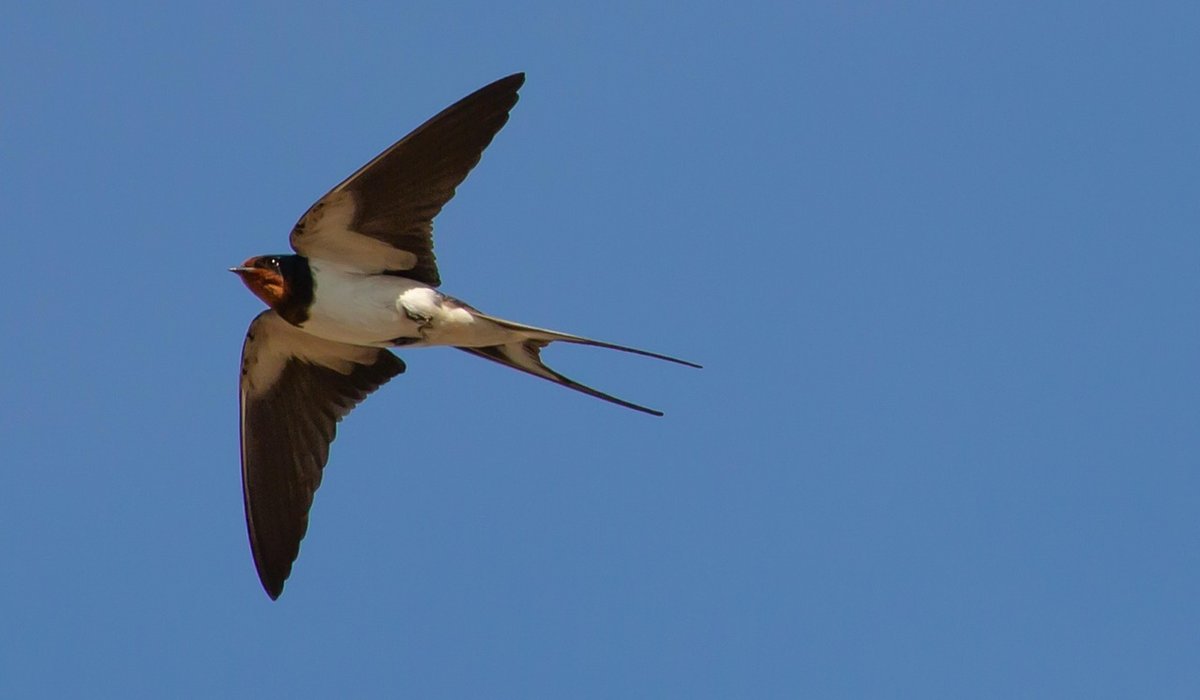
The common swift is one of the most exhilarating birds in the British sky, and also one of the most tantalising. It spends almost its entire life on the wing — feeding, sleeping and even mating in the air — and it cannot perch on a branch or a wire like a swallow. Everything you have to work with is a dark shape against a bright sky, moving fast. The good news is that a swift gives you plenty of clues, and once you know them you will never mistake one for anything else.
Start with the silhouette
Forget colour for a moment and look at shape. A swift in level flight looks like a bow drawn tight: long, narrow, scythe-like wings swept back and slightly down, with the whole bird tapering to points at both ends. Birdwatchers often describe it as an arrowhead or a boomerang. There is no thick barrel of a body, no broad head, no chunk. Swifts are around 16 to 17 centimetres long with a wingspan of roughly 40 centimetres, so the wings are disproportionately long for the size of the bird.
That wing shape is the giveaway. Unlike a swallow, which flaps with quick, shallow beats and glides on flat, angled wings, a swift alternates stiff, flickering wingbeats with long glides in which the wings stay swept back and often held in a shallow V. Watch for the shape rather than the rhythm — silhouettes are far easier to read against a bright sky.
Tail length and the fork
In good light and at close range, a swift shows a short, deeply forked tail. The fork is usually closed up in normal flight, so the tail looks like a small pointed rudder rather than a streamer. This is one of the easiest ways to separate it from a swallow, whose tail is longer overall with two fine outer feathers trailing well behind the body.
- Swift: short tail, forked when spread, but never trailing beyond the wingtips in silhouette.
- Swallow: long forked tail with clear streamers, obvious at almost any distance.
- House martin: short forked tail, but with a bright white rump and white underparts.
- Sand martin: brown above, white below, with a dark chest band and a shallow fork.
If you are looking up at a bird with a tail that seems to stick out behind like a pair of tweezers, it is not a swift.
Colour, and why "black" is misleading
Swifts are dark, but they are not uniformly black. Against a grey cloud they can look sooty brown; in flat sunlight they appear black. In decent light, especially when a bird banks away from you, look for a pale throat patch, a subtle scaling on the underparts, and slightly paler inner wing feathers. The upperparts are a dull brownish black.
This matters because we tend to skew our observations towards what we expect. A swift catching the sun at an angle is a brown bird with a pale chin, not a silhouette cut from card. If the light allows, use it.
Flight style and where it flies
Swifts feed high, often much higher than other hirundines, and they are happy to hunt in the low hundreds of metres on a warm, insect-rich afternoon. They descend to rooftop height in wet, cool weather, when insects are pushed down, and it is then that you get your best views.
Their flight is fast and direct, with bursts of stiff wingbeats followed by long, banking glides. They rarely hover, though they can slow to almost nothing when investigating a nest hole. That is a key habit: a swift flying up to a roof and disappearing into a gap under an eave is almost certainly prospecting for a nest site.
Learn the screaming call
Nothing gives a swift away like its voice. The screaming party is a tight flock of swifts racing around rooftops at dusk or on a warm morning, all calling at once — a shrill, reeling, high-pitched "sreee" that rises and falls as the birds bank. It is the sound of a British summer, and once you know it you will hear swifts long before you see them.
The call is given on the wing, sometimes by single birds, more often by groups near nest sites. Swallows, by contrast, have a pleasant, twittering, liquid song, and house martins a dry, scratchy rattle. The swift's scream has an urgency to it that no other British bird matches.
Swift, swallow or hobby?
The two genuine confusions are the swallow and the hobby, and each is easy to resolve.
A swallow has a rufous throat, creamy underparts, a glossy blue-black back and long tail streamers. It flies lower and flutters more. If you can see any pale underparts or a red throat, it is not a swift.
A hobby is the classic trap. It is roughly swift-sized, dark against the sky and often hunts swifts and martins high up. But a hobby has a more falcon-like build, with a broader chest, pointed wings that look straighter in a glide, a white cheek patch with a dark moustache stripe, and a reddish flush on the underparts and thighs in good light. It also flaps with a looser, more elastic action. Swifts flap stiffly; hobbies row through the air.
Timing your swifts
Swifts arrive in the UK from late April, with the main influx in the first half of May, and most birds leave again in early August, with stragglers into September. That gives you a window of roughly fourteen weeks to practise. Find a street with older houses and deep eaves, or a church tower, and spend half an hour at dusk in late May. Watch the rooftop line, listen for the scream, and let the silhouettes do the rest. Once the shape, the tail and the call are locked in, a swift becomes one of the most recognisable birds in Britain — and one of the most rewarding to count.

4 Comments